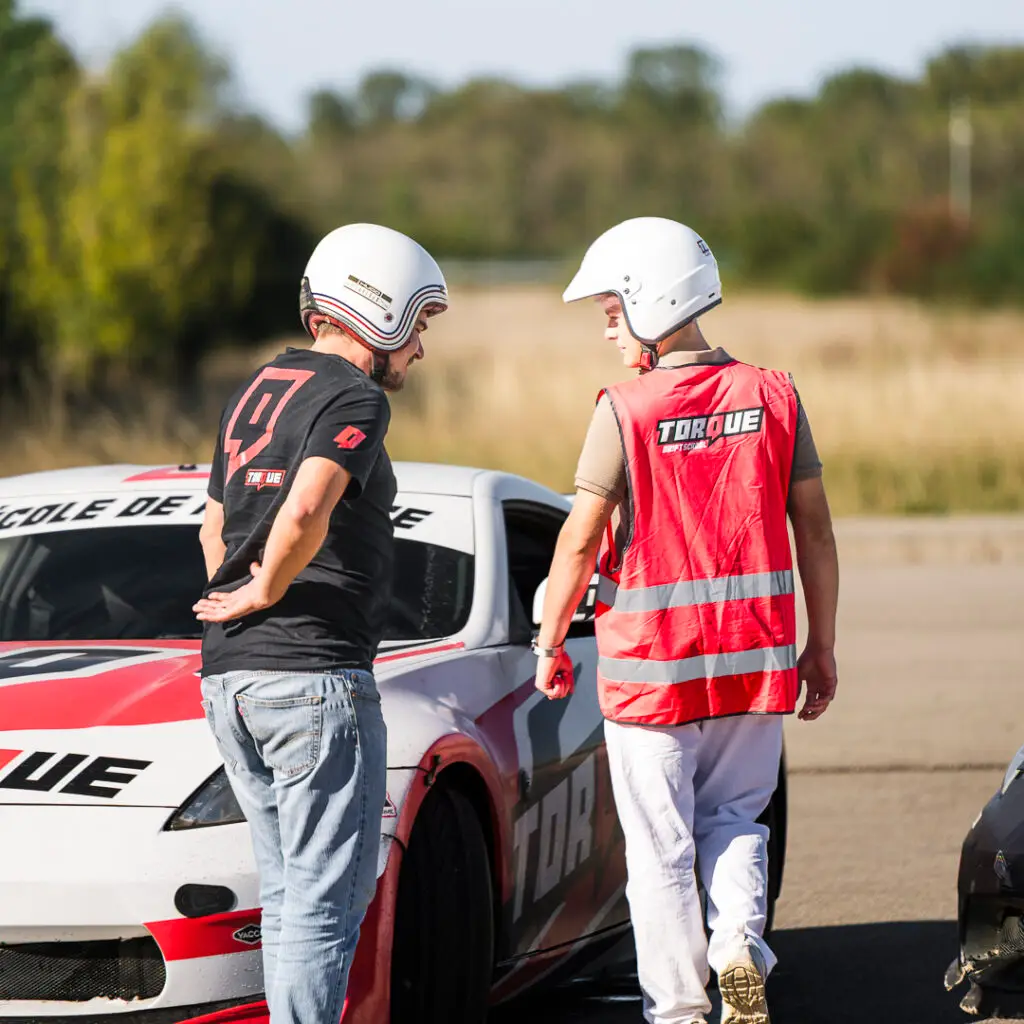
Drifting fascinates with its spectacular style, precision, and the unique sensations it provides. But behind the big slides and impressive angles lies a demanding discipline that requires method, rigor, and progressive learning. At Torque Drift School, we support both beginner and experienced drivers each year in discovering and mastering drifting, on the track and in complete safety.
Here is our complete guide to starting to drift under the right conditions.
Drifting is a driving technique that involves intentionally sliding the rear of the vehicle while maintaining control of the racing line. Unlike an unintentional loss of grip, drifting is anticipated, controlled, and maintained through a precise combination of steering wheel, accelerator, and weight transfer.
The goal is not pure speed, but:
control of the sliding,
precision of placement,
fluidity of drift transitions,
and the ability to maintain a constant angle.
Yes, it is entirely possible to start drifting without any prior driving knowledge or experience. Drifting is even an excellent gateway into motorsport, provided you learn in a supervised and safe environment.
At Torque Drift School, drift driving courses take place on a watered track, which reduces grip, allows for sliding practice at low speeds, and limits mechanical stress. This progressive approach facilitates understanding of weight transfer, opposite lock, and accelerator management, even for a beginner driver.
In addition to courses, drift trackdays are for drivers who want to drive freely on the track, improve consistency, and apply what they’ve learned. They are an ideal step after an initial introduction, to continue progressing at your own pace while benefiting from an environment adapted to drifting.
Contrary to popular belief, it is not essential to own a drift vehicle to start.
To start, a car should ideally be:
a rear-wheel-drive car,
equipped with a limited-slip differential,
mechanically reliable.
Among the most popular models:
BMW E36 / E46
Mazda MX-5
Nissan 350Z / 370Z
Toyota GT86 / Subaru BRZ
At Torque Drift School, we provide Nissan 370Z cars, perfectly prepared for learning, to allow students to focus solely on driving.
During structured learning, several techniques are progressively covered:
Power Slide: A drifting technique that involves using the accelerator to keep the car sliding through a corner. Once the slide is initiated, the driver modulates the throttle to control the angle and continue the drift until exiting the corner.
Feint Drift / Weight Transfer: A technique consisting of initiating a drift to take a corner faster; an initial feint (brief steering input) causes oversteer, then opposite lock allows control of the slide and realigning the wheels to exit the corner.
Handbrake: The handbrake in drifting involves briefly engaging it at corner entry to make the rear wheels lose grip. This action, combined with a slight entry speed, triggers the slide, before progressively accelerating and applying opposite lock to control the drift.
Clutch-Kick: The Clutch Kick involves briefly disengaging the clutch during full acceleration, then abruptly re-engaging it. This action causes a sudden surge in engine RPM and torque to the wheels, leading to a loss of grip and initiating the slide.
Each exercise is designed to develop solid automatic responses before moving on to more complex drift transitions.
The budget for practicing drifting largely depends on the chosen package.
For drift trackdays, track access starts from €200 per day. This price only includes track time. You must therefore add all associated costs such as vehicle transport, fuel, tyre wear, maintenance, and any potential mechanical constraints related to intensive practice.
Conversely, drift driving courses offer a more controlled budget approach. At Torque Drift School, the Discovery package starts at €250 and includes track access, fuel, tyres, insurance, and professional instruction. This solution allows you to discover drifting without worrying about logistical and mechanical costs, while learning in a safe and educational environment.
Drifting cannot be improvised and should never be practiced on open roads. The racetrack offers:
a safe environment,
wide and clear areas,
controlled grip,
and professional instruction.
The racetracks used by Torque Drift School (Circuit du Bourbonnais, Vaison Piste, Circuit de La Ferté-Gaucher, Circuit de Lurcy-Lévis, Circuit des Ecuyers, Driving Center Castellet, Transpolis, etc.) are chosen for their progressivity and their suitability for beginners as well as more experienced drivers.
Starting alone can lead to bad habits that are difficult to correct later. Professional instruction allows you to:
analyze your actions,
immediately correct errors,
adapt exercises to your level,
and progress faster and more confidently.
At Torque Drift School, learning is based on:
pedagogy,
progressivity,
and adaptation to each driver.
Many beginners ask this question. The reality is simple: drifting can remain pure pleasure, without a competition objective.
The courses allow you to:
discover the discipline,
have fun safely,
improve your overall driving skills,
without ranking pressure.
For the most motivated, these solid foundations can then open the door to trackdays, events (Shiftech Drift Series) and potentially competition. (French Drift Championship, Drift Cup, Viking Cup, …)
For a first approach, for those unfamiliar with drifting, we recommend the Discovery package, allowing you to get behind the wheel of one of our Nissan 370Z for 30 minutes accompanied by an instructor. For those wishing to further their learning or refine techniques, the half-day or full-day package offers personalised support aboard our vehicles on a racetrack to acquire solid foundations or push existing skills even further.
It’s the best way to:
understand the fundamentals,
experience your first slides,
and leave with solid technical foundations.
Drifting is much more than a spectacular discipline: it’s a true driving school that develops vehicle control, precision, and racing line reading. Whether you want to discover sliding, improve technically, or lay solid foundations to move on to other motorsport disciplines, learning on a racetrack remains the best approach.
Join our 400 students in 2025, try the experience with Torque Drift School and come learn to drift in a safe environment, supervised by passionate instructors, on France’s most beautiful racetracks.
Découvrez nos stages encadrés, accessibles aux débutants comme aux passionnés.
Conseils, coulisses, événements et informations sur l’univers Torque Drift School.


